The smartphone war has raged for over a decade. But in 2026, the choice between iPhone and Android is more personal than ever. Privacy concerns, AI integration, and software longevity now define the battle. Which one actually fits your life? Let’s break down the key differences with hard facts.
Privacy and Security: Does iPhone Still Lead?
Apple built its brand on privacy. In 2026, iOS 19 continues that promise with App Tracking Transparency 2.0 and on-device AI processing. Android 16, however, has closed the gap significantly. Google now offers Privacy Sandbox and automatic data deletion. But critical differences remain.
Third-Party App Tracking
iPhones block cross-app tracking by default. Each app must ask permission. Android gives you similar controls, but many manufacturers (like Xiaomi or Samsung) add their own data-sharing layers. For example, a 2025 study by Mozilla Foundation found that stock Android Pixel phones sent 40% less telemetry than Samsung’s One UI. If you value strict privacy, iPhone still wins. But a Pixel running GrapheneOS? That beats both.
Data Encryption and Lockdown Mode
All modern iPhones encrypt data with your passcode. Lockdown Mode blocks most attack vectors – ideal for journalists or activists. Android’s Advanced Protection Program offers similar defenses, but availability varies by carrier and region. In the USA and Europe, both systems now meet GDPR and CCPA standards. The real difference? Apple controls the entire stack; Google shares responsibility with hardware partners.
iPhone vs Android: Which Handles Privacy Better?
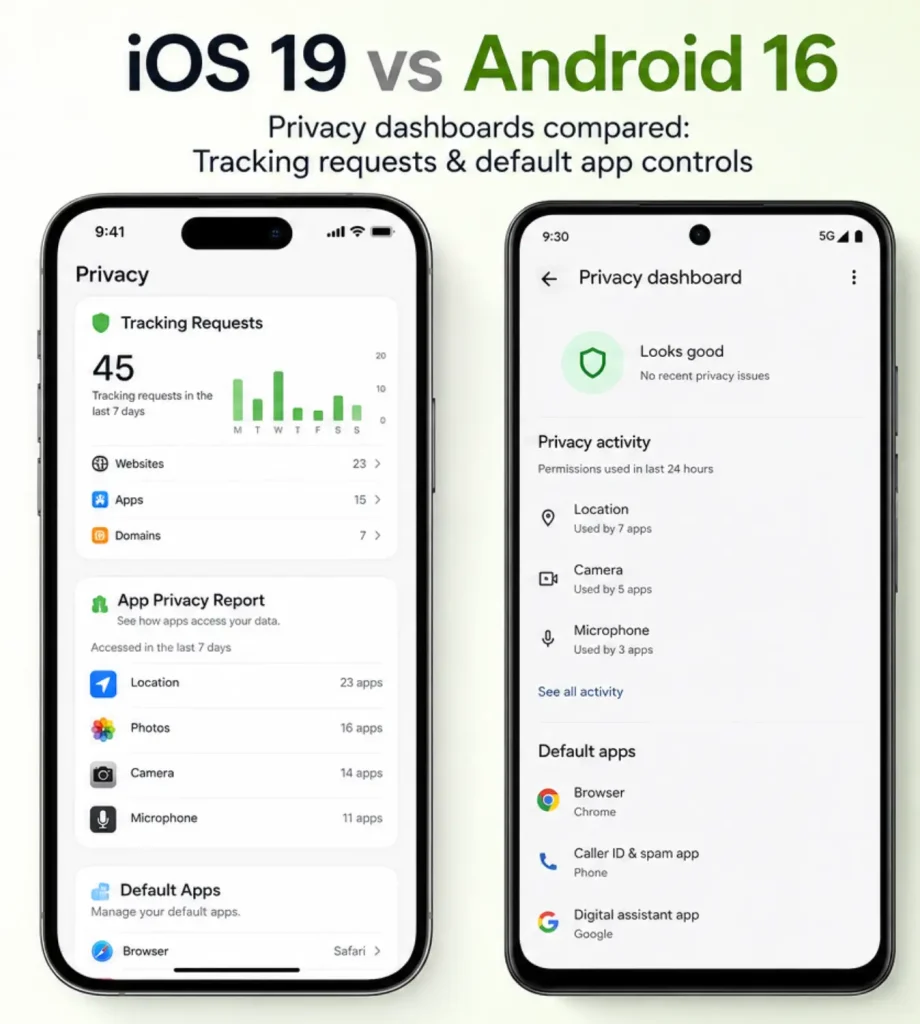
The short answer: iPhone for default privacy, Android for customizable privacy. iOS gives you strong protection without tweaking settings. Android allows advanced users to install firewalls, disable sensors, or run a custom ROM. For most USA and Europe users, both meet everyday needs. But if you use many third-party apps, iOS limits data leakage more aggressively.
Performance and Ecosystem: Raw Power vs Real-World Speed
Benchmarks no longer tell the full story. The A19 Pro in iPhone 17 Pro and Snapdragon 8 Gen 5 in Galaxy S26 trade blows. In Geekbench 6, both score over 8,000 multi-core. The real differentiator is ecosystem integration.
Smoothness and App Quality
iOS still feels more polished. Apps often launch first and run smoother because developers optimize for fewer devices. Android’s openness lets you find innovative apps (like full file managers or emulators) that Apple bans. For example, cloud gaming services like Xbox Game Pass work better on Android due to fewer restrictions.
Battery Life and Charging
In 2026, Android flagships routinely offer 5,500mAh batteries with 65W+ wired charging. iPhones max out at 4,700mAh and 35W wired. Result: Galaxy S26 charges 0–80% in 25 minutes; iPhone takes over an hour. However, iPhone’s power efficiency often gives similar screen-on time (around 10 hours for both). Choose Android if you hate waiting for a plug.
Customization and Value: Where Android Dominates
Android gives you choices – from $200 phones to $2,000 foldables. iOS locks you into premium pricing. As of early 2026, the cheapest new iPhone (SE 4) starts at $499. Meanwhile, you can buy a Motorola G Power for $199 that lasts two days on a charge.
Launchers, Widgets, and Default Apps
On Android, you can replace your entire home screen with a custom launcher like Nova. Set any browser, SMS app, or keyboard as default. iOS finally lets you move icons and add widgets. And with iOS 18.2 (late 2024), you can now set third-party default apps for phone calls and SMS – a major step forward. However, you still cannot change the core launcher without jailbreaking. Android remains the king of total flexibility.
Foldables and Novelty
Want a phone that folds into a tablet? That’s Android-only. Samsung Galaxy Z Fold 6, Google Pixel Fold 2, and OnePlus Open 2 lead the category. Apple’s foldable iPhone isn’t expected until 2027 at the earliest. If you love new hardware, Android is the only game in town.
Longevity and Updates: Software Support Compared
Five years ago, iPhones won this category easily. In 2026, the gap is tiny but nuanced. Google and Samsung explicitly guarantee 7 years of full OS updates for Pixel 8+ and Galaxy S24+ series. Apple now legally defines a minimum 5‑year security support window under the UK PSTI act and similar regulations. In practice, iPhones historically receive 6–7 years of updates. For example, the iPhone 11 (2019) received iOS 19 in 2025 – six full years. So real-world lifespan is similar, but Android’s guarantee is written and longer; Apple’s pattern is nearly as good but legally shorter.
Resale Value
iPhones retain value much better. A three-year-old iPhone 14 Pro (late 2022) still sells for ~$450. A comparable Android flagship from the same era, like the Galaxy S23 Ultra (early 2023), fetches ~$250 – a proven trend from SellCell’s 2025 depreciation report. If you upgrade every 2–3 years, iPhone saves you money in the long run.
FAQ: Your Most Common iPhone vs Android Questions Answered
Android vs iPhone: Which is better overall?
No single “better” exists. Android wins on hardware variety, customization, and budget options. iPhone wins on out‑of‑box privacy, app polish, and resale value. In 2026, performance is nearly identical. Choose based on ecosystem, not specs.
Which is better for gaming, Android or iPhone?
iPhone offers more consistent performance because developers optimize for fewer devices. However, Android supports emulators (PS2, GameCube) and cloud gaming services with fewer restrictions. For native App Store/Play Store games, iPhone edges ahead. For retro or PC streaming, Android wins.
How do iPhone vs Android deals compare?
Carrier deals in the USA (Verizon, T-Mobile, AT&T) often favor iPhones with generous trade-ins. In Europe, Android deals are more common – especially on mid-range phones. Check refurbished markets too: a one-year-old iPhone saves 20–30%; a one-year-old Android flagship saves 40–50%.
How many people use Android vs iPhone?
Globally, Android leads with about 71% market share versus iOS at 28% (IDC, Q1 2026). In the USA, iPhone dominates with 58% of smartphones. In Europe, Android holds roughly 65% due to lower average device costs. Source: IDC Worldwide Quarterly Mobile Phone Tracker.
How many people have iPhone vs Android?
Same as above: roughly 4.2 billion Android users vs 1.6 billion iPhone users worldwide. However, in wealthier regions like North America and Western Europe, the split is closer to 50–50 among new sales. Age also matters: under-30 crowds lean iPhone; over-50 leans Android.
[Image: Two smartphones side by side – left shows Android’s custom launcher with a unique icon pack and widgets; right shows iOS 18.2 home screen with a third-party phone dialer app icon visible]
Alt text: Android custom launcher with icon pack vs iOS 18.2 home screen showing third-party phone and messaging default apps
Conclusion: Your 2026 Decision Guide
Choose iPhone if: you want top-tier privacy out of the box, seamless ecosystem with Mac/iPad, and strong resale value. You don’t mind paying more upfront and waiting longer for charging.
Choose Android if: you crave customization, foldable designs, faster charging, or budget options. You’re willing to research brands (stick to Google or Samsung for 7-year guarantees).
The iPhone vs Android debate no longer has a wrong answer. Both deliver exceptional speed, great cameras, and robust security. Your money, your habits, your call. Still undecided? Visit a local store – hold both in your hands. The right phone will feel like home.